- Rehman
- 1:04 pm
- April 16, 2026
If you’ve been researching how to rank your website on Google, you’ve probably come across these two terms more than once — on-page SEO and off-page SEO. And if you’re honest, they still feel a little blurry.
You’re not alone. Most beginners — and even some experienced marketers — mix them up, underestimate one, or worse, ignore both while wondering why their site isn’t moving.
Here’s the truth: both matter. But they don’t matter equally at every stage of your website’s growth. Knowing which one to prioritize right now can save you months of wasted effort.
In this guide, we’ll break down exactly what on-page and off-page SEO are, what makes them different, and — most importantly — which one you should be focusing on first.
What Is On-Page SEO?
On-page SEO refers to every optimization you make directly on your website — the things you fully control. Think of it as preparing your house before inviting guests. If the house is messy, unclear, or hard to navigate, people will leave — and so will Google.

On-page SEO covers:
- Title Tags & Meta Descriptions — The first thing both users and search engines see in results
- Keyword Optimization — Using your target keywords naturally in headings, body content, and URLs
- Content Quality & Depth — Comprehensive, well-structured content that genuinely answers the user’s question
- Internal Linking — Connecting your pages to each other so Google can understand your site’s structure
- Image Alt Text — Describing images so search engines know what they show
- URL Structure / Slugs — Clean, readable URLs that include your keyword
- Page Speed & Mobile Responsiveness — Fast, mobile-friendly pages rank higher, period
- Schema Markup — Structured data that helps Google display rich results
When a search engine crawls your site, on-page SEO is the first thing it evaluates. If your on-page SEO is weak, no amount of backlinks will save you. Think of it as your foundation — everything else is built on top of it.
At Alpha Digitix, every SEO strategy we build starts with a complete on-page audit — because fixing the foundation always comes first.
What Is Off-Page SEO?
Off-page SEO is everything that happens outside your website that signals to Google: “This site is trustworthy and authoritative.”
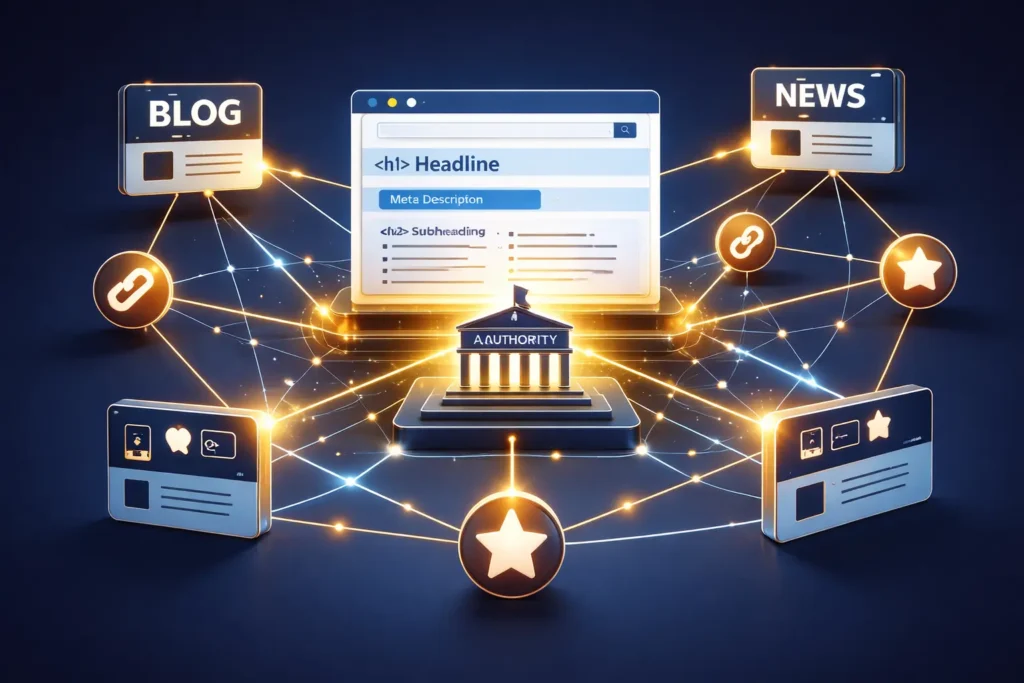
If on-page SEO is about what your website says about itself, off-page SEO is about what the rest of the internet says about you.
The most important off-page SEO factors include:
- Backlinks — Links from other websites pointing to yours. The more high-authority sites link to you, the more Google trusts you
- Domain Authority (DA) — A score that reflects how well-established your site is, built over time through consistent backlink acquisition
- Brand Mentions — Even unlinked mentions of your brand name signal relevance to Google in 2026
- Guest Posting — Publishing articles on other websites to earn backlinks and exposure
- Social Signals — Shares, engagement, and visibility on social platforms contribute indirectly to authority
- Digital PR — Getting featured in online publications, industry blogs, and news sites
Off-page SEO is essentially your online reputation. And just like a real-world reputation, it takes time to build — but once it’s strong, it’s incredibly powerful.
On-Page SEO vs Off-Page SEO: Side-by-Side Comparison
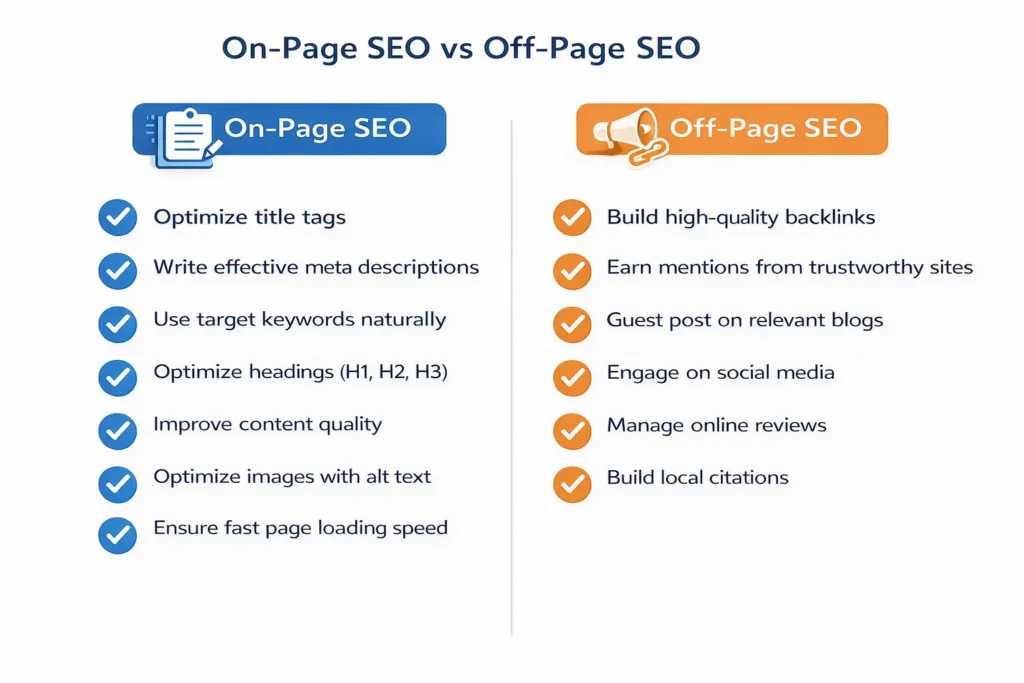
| Factor | On-Page SEO | Off-Page SEO |
|---|---|---|
| Where it happens | On your website | Outside your website |
| What it controls | Content, structure, tags, speed | Backlinks, mentions, authority |
| Who controls it | You | Others (partially) |
| Time to see results | Faster (weeks to months) | Slower (months to years) |
| Best for | New websites, content optimization | Established sites, competitive keywords |
| Primary goal | Relevance & usability | Authority & trust |
| Difficulty | Moderate | High (requires outreach) |
Which One Matters More in 2026?
This is the question everyone asks — and the honest answer is: on-page SEO comes first, always.
Here’s why. Google’s AI-powered ranking systems in 2026 first check whether your page genuinely matches what the user is searching for. If your content is thin, poorly structured, or keyword-stuffed, all the backlinks in the world won’t push you to page one.
Consider it this way: backlinks are like votes. But if what you’re offering isn’t good, people won’t vote for you — and even if they do, visitors will leave within seconds, and Google notices that bounce rate.
On the other hand, off-page SEO becomes critical once your on-page foundation is solid. For competitive keywords — the ones where every result on page one has strong authority — you’ll need backlinks to compete. Content alone won’t be enough.
So the priority order looks like this:
- Get your on-page SEO right first — content, structure, keywords, speed
- Build internal links between your pages
- Start off-page efforts — guest posting, outreach, digital PR
- Maintain both consistently over time
If you’re running a new website, pour most of your energy into on-page SEO for the first 3–6 months. Get your content right, target low-competition keywords, and let Google learn what your site is about. Then scale your off-page efforts.
Need help building an SEO strategy that covers both? Our professional SEO services at Alpha Digitix are built to handle exactly this — from technical on-page audits to authority-building campaigns.
Common Mistakes People Make With On-Page and Off-Page SEO
Even well-intentioned website owners get this wrong. Here are the most common mistakes — and how to avoid them:
Mistake 1: Jumping into link building before the content is ready Backlinks pointing to a poorly optimized page won’t stick. Fix your on-page SEO before you start outreach.
Mistake 2: Keyword stuffing Using your target keyword 20 times in a 1,000-word post doesn’t make Google happy — it makes Google suspicious. Aim for 1–1.5% keyword density and let LSI keywords do the rest.
Mistake 3: Ignoring internal links Internal links help Google understand the relationship between your pages. Every post should link to at least 2–3 other relevant pages on your site. This is also one of the fastest wins in on-page SEO you can implement today.
Mistake 4: Chasing low-quality backlinks 100 backlinks from spammy sites will hurt more than help. 5 backlinks from high-authority, relevant domains are worth far more.
Mistake 5: Treating SEO as a one-time task SEO is not a campaign. It’s an ongoing process. Algorithms change, competitors publish new content, and your rankings need consistent attention.
How On-Page and Off-Page SEO Work Together
Here’s the mental model that makes everything click:
On-page SEO = What your website says about itself Off-page SEO = What the internet says about your website
Google needs both signals to rank you with confidence. A page with excellent content but zero backlinks might rank for low-competition keywords. A page with hundreds of backlinks but poor content will rank temporarily and then drop when users don’t engage.
The sites that dominate page one — and stay there — have both working in sync. Strong, well-optimized content that earns natural backlinks over time because people genuinely find it useful.
That’s the real SEO strategy. Not a trick. Not a shortcut. Just good content backed by real authority.
If your business is ready to build both, our team at Alpha Digitix offers end-to-end SEO services that cover on-page optimization, technical SEO, and off-page authority building — so you don’t have to figure it out alone.
Conclusion
On-page SEO and off-page SEO are not competitors — they’re partners. One without the other will always have a ceiling.
Start with on-page SEO. Build content that’s genuinely helpful, technically clean, and properly optimized for the right keywords. Once that foundation is solid, begin your off-page efforts — earn backlinks, build your brand’s presence, and let your authority grow.
The websites winning in Google in 2026 aren’t winning because of a single tactic. They’re winning because they’ve built something worth ranking.
Ready to get started? Get in touch with Alpha Digitix — and let’s build an SEO strategy that actually works for your business.
Frequently Asked Questions (FAQs)
Yes — especially for low-competition and long-tail keywords. Many new websites rank successfully in the early stages with solid on-page SEO alone. However, for competitive keywords, backlinks will eventually be necessary.
Typically 4–12 weeks for Google to index and evaluate your changes. Some improvements — especially on already-indexed pages — can show results in as little as 2–3 weeks.
No. While backlinks are the most important off-page signal, brand mentions, social media presence, guest posting, digital PR, and online reviews all contribute to off-page authority in 2026.
On-page SEO is easier because you control it entirely. Off-page SEO requires outreach, relationship building, and often time and resources — making it more challenging, especially for new websites.
Basic on-page SEO can be learned and implemented yourself. However, for competitive keywords, technical audits, and off-page campaigns, working with a professional SEO agency delivers significantly faster and more sustainable results.