- Rehman
- 5:13 am
- April 23, 2026
Every business wants to be on the first page of Google. And for good reason — if you’re not there, you’re essentially invisible to the people actively searching for what you offer.
But here’s what most “how to rank on Google” guides won’t tell you: what worked in 2022 or 2023 doesn’t cut it anymore. Google’s algorithm has evolved dramatically. In 2026, it doesn’t just match keywords — it evaluates your content for quality, your site for trustworthiness, and your entire web presence for genuine authority.
The good news? The fundamentals are clearer than ever. And if you follow the right steps in the right order, ranking on Google is absolutely achievable — even for newer websites.
This guide breaks it down step by step, in plain English, without the fluff.
What Google Actually Looks for in 2026
Before we get into the steps, let’s quickly understand what Google is evaluating when it decides who ranks.
Google uses over 200 known ranking signals — but the dominant ones in 2026 are content quality, E-E-A-T (Experience, Expertise, Authoritativeness, and Trustworthiness), backlinks from authoritative sites, Core Web Vitals, and how well your page matches what a searcher actually wants.
In 2026, Google uses layered systems — spam detection, relevance scoring, page experience, and quality evaluation — then blends those signals with AI models that interpret meaning and intent. That’s why two pages with similar keywords can rank wildly differently.
The practical takeaway: surface-level optimization isn’t enough anymore. You need to genuinely help your reader, build real authority, and ensure your site is technically sound. Do all three and you give Google exactly what it needs to rank you.
Step 1: Start With the Right Keyword Research
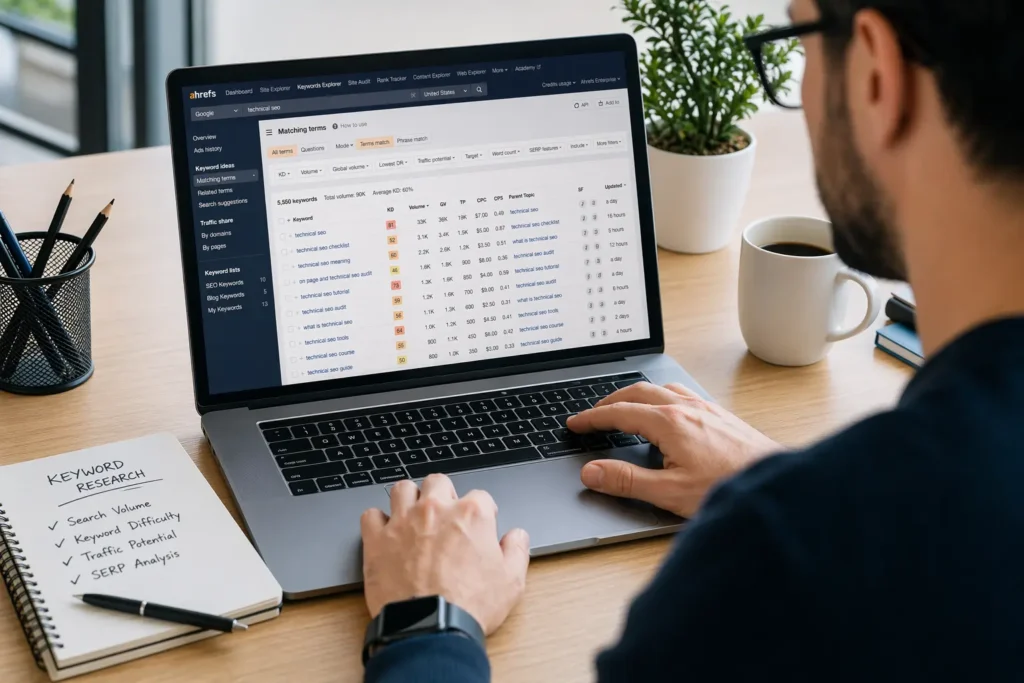
Everything in SEO begins with keywords — but not just any keywords. The most common mistake beginners make is targeting keywords that are too competitive too early.
Here’s how to approach keyword research strategically:
Find keywords you can actually win: New and growing websites should target keywords with moderate search volume and lower competition. A keyword with 500 monthly searches and low competition is infinitely more valuable than a keyword with 50,000 searches that you’ll never rank for.
Understand search intent: Every keyword has an intent behind it — what is the person actually looking for?
- Informational — “what is technical SEO” (they want to learn)
- Commercial — “best SEO agency UAE” (they’re comparing options)
- Transactional — “hire SEO expert” (they’re ready to buy)
Match your content type to the intent. Google is exceptionally good at recognizing mismatches — and penalizing them with poor rankings.
Use long-tail keywords: Long-tail keywords — longer, more specific phrases — have lower competition and higher conversion rates. “How to rank on Google for small business 2026” beats trying to rank for “Google ranking” from day one.
Tools to use:
- Google Search Console (free — shows what you already rank for)
- Google Keyword Planner (free)
- Ubersuggest, Ahrefs, or Semrush for deeper research
At Alpha Digitix, our SEO services always start with a thorough keyword research phase — because targeting the wrong keywords wastes months of effort.
Step 2: Fix Your Technical SEO Foundation
Before you write a single word of content, make sure Google can actually find and crawl your website. Technical SEO is the foundation everything else sits on.
Key technical SEO priorities:
Enable HTTPS Your site must have an SSL certificate. HTTP sites are flagged as “Not Secure” in browsers and are penalized by Google.
Submit an XML Sitemap Submit your sitemap to Google Search Console so Google can discover all your pages efficiently.
Fix Crawl Errors Check Google Search Console regularly for crawl errors — pages Google can’t access. Fix broken links and remove redirect chains.
Improve Site Speed Google updated Core Web Vitals in 2026, making Interaction to Next Paint (INP) and scroll performance metrics critical for ranking. Run your site through Google PageSpeed Insights and address the issues it highlights.
Ensure Mobile-Friendliness Google uses mobile-first indexing — your mobile version determines your rankings. If your site isn’t responsive, you’re already behind.
A professionally built website handles most of these technical requirements automatically — which is why the foundation you start with matters enormously.
Step 3: Nail Your On-Page SEO
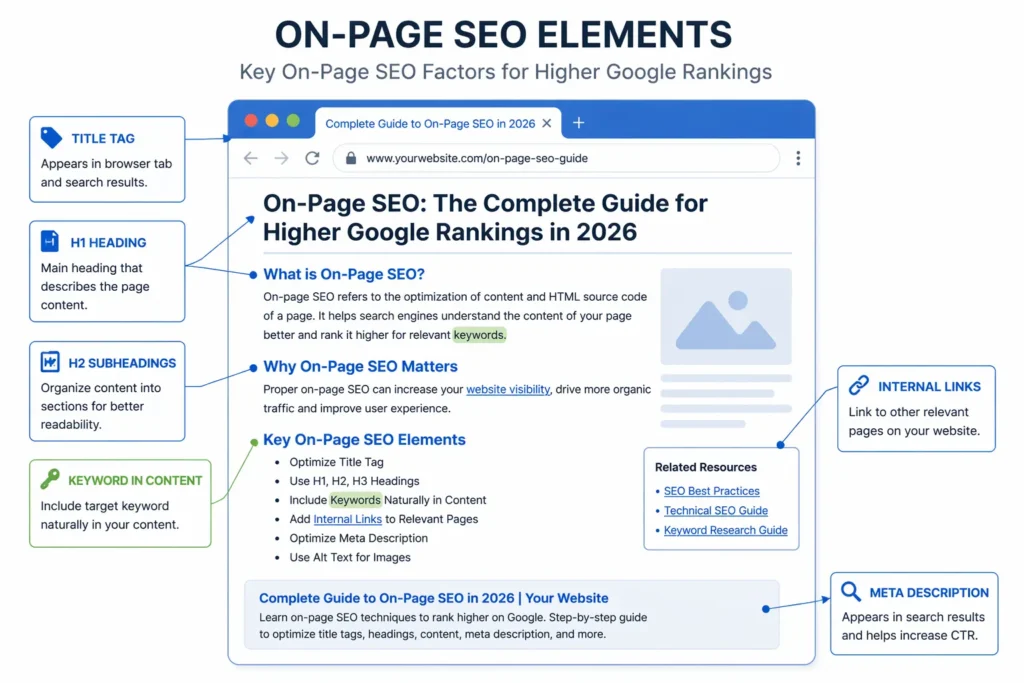
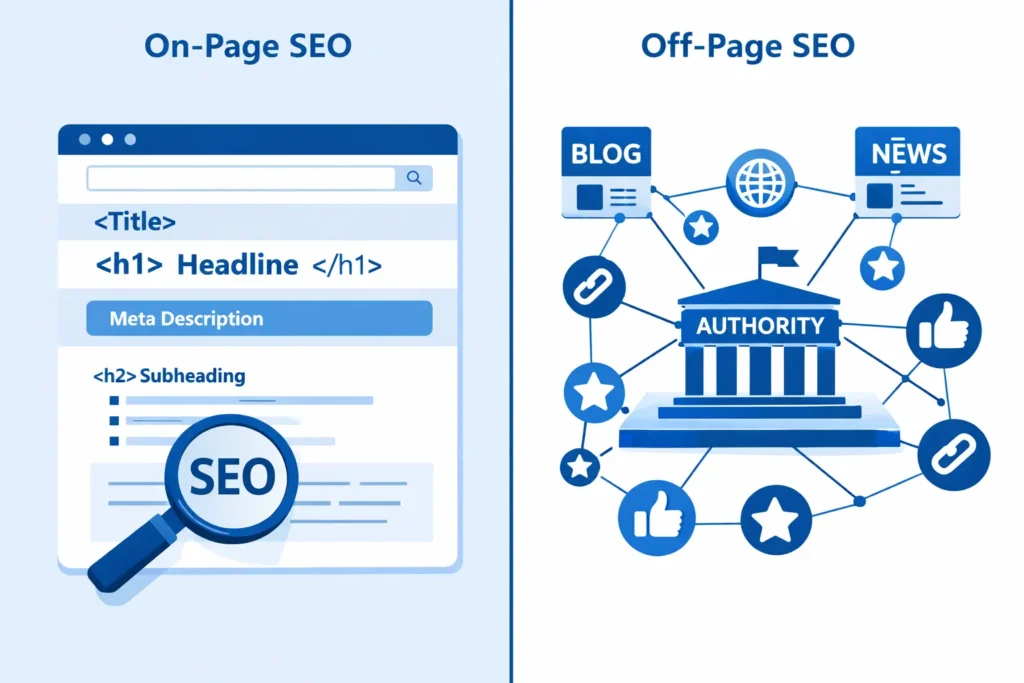
On-page SEO is everything you optimize directly on each page of your website. This is where most of the day-to-day SEO work happens.
Here’s what to optimize on every page you publish:
Title Tag (SEO Title) Your title tag should include your primary keyword — ideally near the beginning — and stay under 60 characters. It’s the first thing both Google and users see in search results.
Meta Description Write a compelling 145–155 character meta description that includes your keyword and gives the reader a reason to click. It won’t directly boost rankings, but it dramatically improves click-through rate — which does.
URL / Slug Keep your URL short, clean, and keyword-rich. /how-to-rank-on-google beats /blog/post-1234 every time.
H1 and H2 Headings Your H1 should contain your primary keyword. H2s should include secondary keywords and LSI terms naturally — not forced.
Keyword Density Use your primary keyword at 1–1.5% density. Mention it in the first 100 words, in at least one H2, and in the conclusion. Let related terms fill the rest naturally.
Internal Links Link to other relevant pages on your website within every post. This helps Google understand your site structure and keeps readers engaged longer — both of which improve rankings.
Image Alt Text Every image needs descriptive alt text that includes relevant keywords. Alt text helps Google understand what your images show and contributes to your overall page relevance.
Step 4: Create Content That Actually Deserves to Rank
In 2026, Google doesn’t reward content that just covers a topic — it rewards content that genuinely satisfies the reader’s intent better than everything else on page one.
Google increasingly emphasizes E-E-A-T — your content should reflect first-hand experience, subject-matter expertise, credibility, and trust. Incorporating personal insights or case studies demonstrates practical experience, which is particularly effective for advice-based content.
Here’s what high-ranking content looks like in 2026:
Comprehensive coverage Don’t just answer the question — answer every follow-up question the reader might have. Google rewards content that fully satisfies search intent without forcing the user to go back and search again.
Clear structure Use H2 and H3 headings to break content into scannable sections. Add tables, bullet points, and numbered lists where they add clarity. A well-structured page keeps readers on it longer — and Google tracks that.
Original insights Generic content that rephrases what everyone else has already said ranks poorly. Add your own perspective, experience, or data. At Alpha Digitix, we’ve seen firsthand that content with original agency insights outperforms generic how-to posts consistently.
Appropriate length Longer isn’t always better — but comprehensive is. For competitive topics, 1,500–2,500 words gives you enough space to cover a topic properly. For simple queries, 800 words might be perfect. Match length to what the topic actually requires.
Regular updates Google favors fresh content. Update your most important posts at least once a year with new information, updated statistics, and improved sections.
Step 5: Build Backlinks That Actually Work
Backlinks — links from other websites pointing to yours — remain one of Google’s strongest ranking signals. But quality matters infinitely more than quantity.
Building authority takes time and there is no shortcut — especially for newer domains competing against sites that have been building authority for 10 to 15 years.
Here’s how to build backlinks that actually move the needle:
Guest Posting Write valuable articles for reputable websites in your niche. Include a contextual link back to your site. One guest post on a high-authority site is worth more than 100 links from low-quality directories.
Create Link-Worthy Content Original research, comprehensive guides, unique data, and helpful tools naturally attract backlinks. When your content is genuinely the best resource on a topic, other websites link to it without you asking.
Digital PR Get your business featured in industry publications, news sites, and relevant blogs. Brand mentions — even without a direct link — signal authority to Google in 2026.
Internal Linking (Often Overlooked) Every new post you publish should link to existing posts, and your existing posts should link back to it. Internal links distribute authority throughout your site and help Google discover new content faster.
What to avoid: Buying backlinks, using link farms, or participating in link schemes. Google’s SpamBrain system is sophisticated enough to detect and penalize manipulative link building — and the consequences can take months to recover from.
Step 6: Optimize for E-E-A-T
E-E-A-T — Experience, Expertise, Authoritativeness, and Trustworthiness — is Google’s framework for evaluating whether your content and website deserve to be trusted.
Even if your page is relevant, Google still asks: can we trust this source? In 2026, that trust comes from visible experience, clear expertise, real authority signals, and transparent site trust elements.
Here’s how to demonstrate E-E-A-T on your website:
- Author bio — Show who wrote the content and what qualifies them
- About page — Tell your story, your team, your credentials
- Contact information — A real business address, email, and phone number builds trust
- Reviews and testimonials — Social proof from real clients signals trustworthiness
- Consistent publishing — Regular, quality content signals that your site is actively maintained by real experts
- Schema markup — Structured data helps Google understand your content type and display rich results
Step 7: Track, Measure, and Improve
SEO is not a set-and-forget strategy. What you measure, you can improve.
Google Search Console (free) Your most important SEO tool. Track which keywords you rank for, monitor impressions and clicks, check Core Web Vitals, and catch crawl errors before they cost you rankings.
Google Analytics (free) Understand where your traffic comes from, how long visitors stay, and which pages perform best. High bounce rates on specific pages signal that your content isn’t meeting expectations — fix it.
Key metrics to track monthly:
- Keyword rankings (which positions are improving or dropping)
- Organic traffic (overall trend over 30/60/90 days)
- Click-through rate (are people clicking your results?)
- Core Web Vitals scores
- Number of indexed pages
Your Complete Google Ranking Checklist for 2026
Before publishing any page, run through this checklist:
| SEO Element | Done? |
|---|---|
| Primary keyword researched and confirmed | ☐ |
| Search intent understood and matched | ☐ |
| SEO title includes keyword (under 60 chars) | ☐ |
| Meta description written (145–155 chars) | ☐ |
| Slug is short and keyword-rich | ☐ |
| Keyword appears in first 100 words | ☐ |
| H2 headings include secondary keywords | ☐ |
| 3–5 internal links added | ☐ |
| All images have descriptive alt text | ☐ |
| Content is comprehensive and intent-matched | ☐ |
| Page loads fast on mobile | ☐ |
| Schema markup added (FAQ, Article, etc.) | ☐ |
| Post submitted to Google Search Console | ☐ |
If you can check every box on this list, your page is in the top tier of what Google rewards in 2026.
How Long Does It Take to Rank on Google?
This is the question every website owner asks — and the honest answer depends on several factors.
For low-competition, long-tail keywords on a well-optimized new site, you can see rankings appear within 4–8 weeks. For moderately competitive keywords, expect 3–6 months. For highly competitive terms in established niches, meaningful rankings can take 6–12 months or longer — even with excellent SEO.
The key is to start now. Every week you wait is a week your competitors are building authority you’ll have to catch up to.
If you want to accelerate the process with professional SEO support, our team at Alpha Digitix builds and executes complete SEO strategies — from technical audits to content creation to link building — so you can focus on running your business while your rankings grow.
Conclusion
Ranking on Google in 2026 isn’t a mystery. It’s a process — and it rewards businesses that commit to it consistently.
Start with keyword research. Fix your technical foundation. Optimize every page properly. Create content that genuinely helps your audience. Build real authority through backlinks and E-E-A-T signals. Then measure, improve, and repeat.
It takes time. It takes effort. But the businesses investing in SEO today are building traffic engines that will deliver leads and revenue for years — without paying per click.
Ready to stop waiting and start ranking? Get in touch with Alpha Digitix and let’s build an SEO strategy that gets your business to page one.
Frequently Asked Questions (FAQs)
It depends on your keyword competition, domain authority, and content quality. For low-competition keywords, you can rank within 4–8 weeks. For moderate competition, expect 3–6 months. Highly competitive terms can take 6–12 months or more. Starting with lower-competition keywords and building authority over time is the smartest approach.
Yes — especially by targeting low-competition, long-tail keywords early on. New websites won't outrank established domains for highly competitive terms right away, but by consistently publishing quality content and building authority, rankings grow steadily.
Keyword density still matters, but it's no longer about hitting a specific percentage. Aim for natural usage of your primary keyword at around 1–1.5% and let related terms fill in organically. Google's AI now understands context and intent — keyword stuffing actively hurts rankings.
For low-competition keywords, strong on-page SEO and quality content can rank without many backlinks. But for competitive keywords, a strong backlink profile is essential. Focus on earning quality links from relevant, authoritative sources rather than chasing quantity.
There's no single factor — Google evaluates a combination of signals. But in 2026, content quality and search intent match, E-E-A-T signals, Core Web Vitals, and authoritative backlinks carry the most weight. Getting all of these right together is what puts you on page one and keeps you there.