- Rehman
- 1:34 am
- April 30, 2026
If you’ve been running a business — or thinking about starting one — you’ve probably heard “digital marketing” more times than you can count. Everyone says you need it. However, not everyone explains what it actually means, how it works, or where someone is supposed to begin.
That’s exactly what this guide is for.
No overwhelming technical detail. Just a clear, honest explanation of what digital marketing is, why it matters for your business in 2026, what channels are involved, and how to think about getting started — whether you’re a complete beginner or someone who’s dabbled but wants a clearer picture.
Let’s start from the beginning.
What Is Digital Marketing?
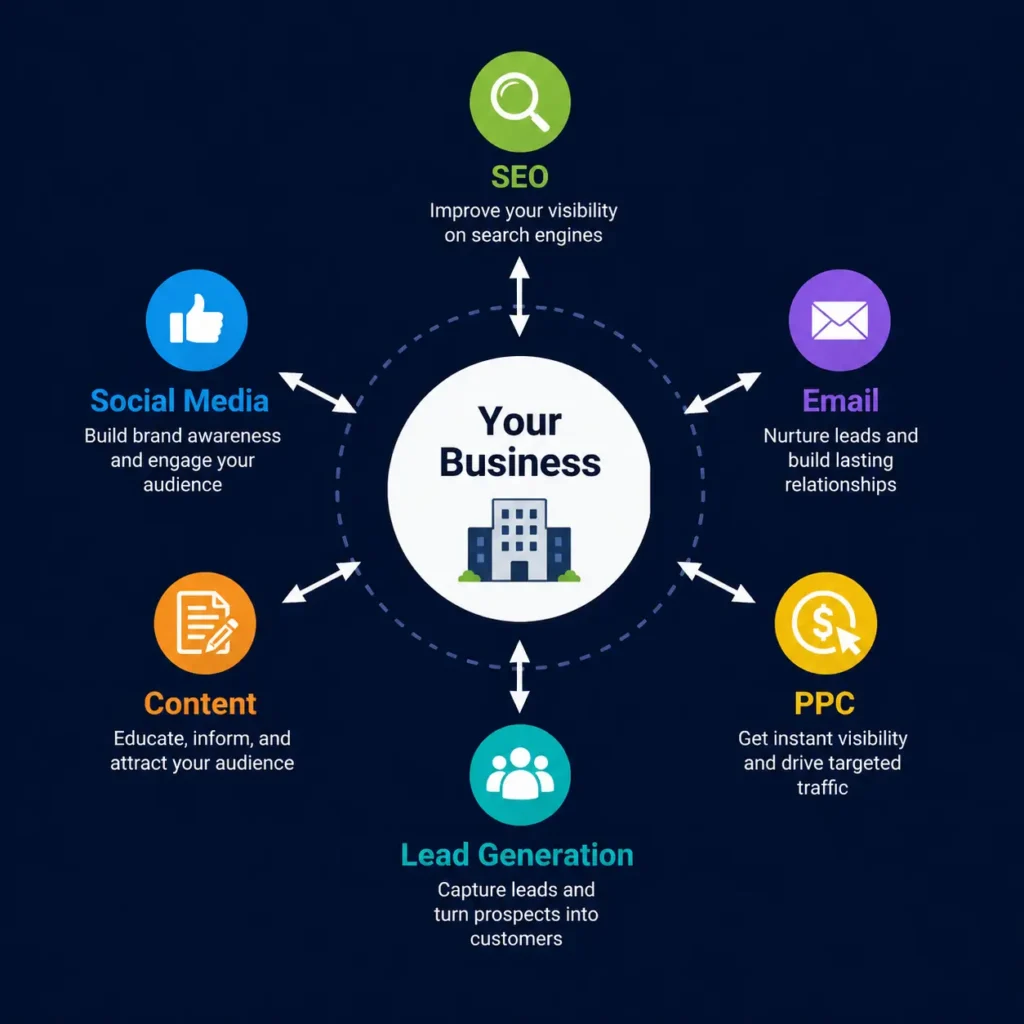
Think about the last time you Googled something, scrolled through Instagram, or got an email from a brand you like. That was digital marketing in action. It’s how businesses reach their customers online — through search engines, social media, email, and more.
In simpler terms: if you’re using the internet to attract customers, sell your products, or build your brand, you’re doing digital marketing.
It’s the online equivalent of everything traditional marketing used to do — print ads, billboards, TV commercials, cold calls — except it’s faster, more measurable, more targeted, and in most cases, significantly more cost-effective.
Digital marketing in 2026 has changed a lot — and honestly, the old tricks just don’t work anymore.
Remember when brands would blast you with ads every five minutes or flood your inbox with emails you never asked for? People got tired of that. And let’s be honest — people today can smell a fake ad from a mile away. They’re smarter, more aware, and they scroll past anything that feels forced.
Today, it’s not about who shouts the loudest. It’s about showing up at the right moment, with the right message, for the right person. Less noise, more meaning.
That means the businesses winning at digital marketing in 2026 aren’t necessarily the ones with the biggest budgets. They’re the ones with the clearest strategy, the most relevant content, and the strongest connection to their audience.
Digital Marketing vs Traditional Marketing
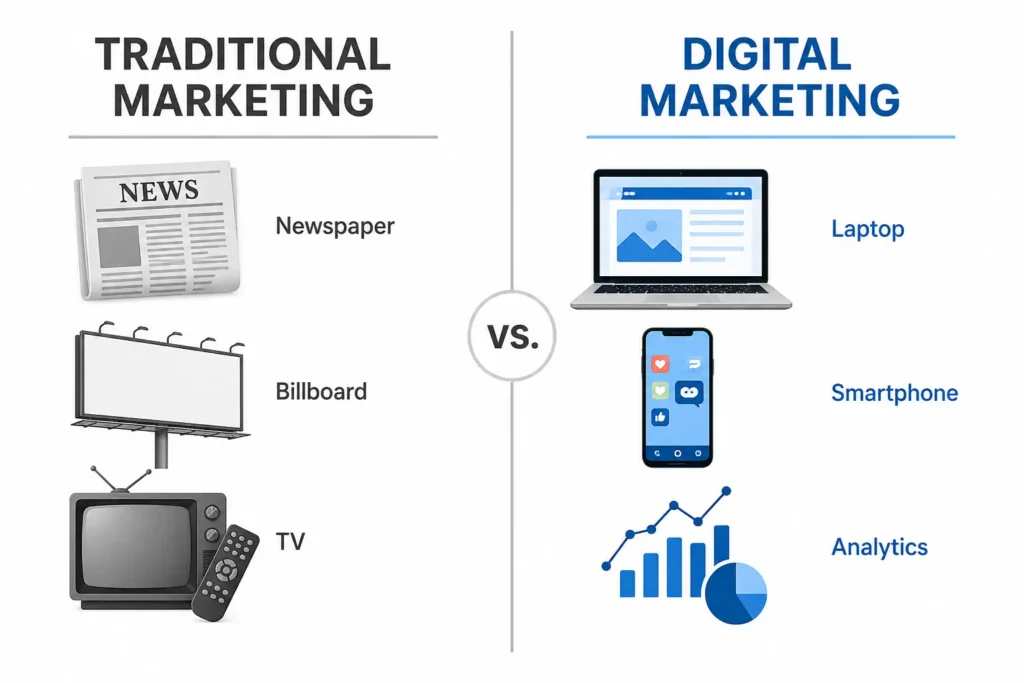
Before we go deeper, let’s quickly clarify the difference — because it’s important.
| Factor | Traditional Marketing | Digital Marketing |
|---|---|---|
| Channels | TV, radio, newspapers, billboards | Search, social media, email, websites |
| Cost | High — production and placement fees | Flexible — can start with very small budgets |
| Targeting | Broad — reaches anyone in the area | Precise — targets specific demographics, interests, behaviors |
| Measurability | Difficult — hard to track results | Highly measurable — data for every action |
| Reach | Local or national | Global — anyone with internet access |
| Interaction | One-way — business talks to customer | Two-way — customers can respond, engage, share |
| Speed | Slow — campaigns take weeks to set up | Fast — campaigns can launch in hours
|
The shift to digital doesn’t mean traditional marketing is dead — but for most small and medium businesses, digital marketing delivers far better ROI, far more measurable results, and far greater reach at a fraction of the traditional cost.
How Does Digital Marketing Work?
Digital marketing works by placing your business in front of people who are already looking for what you offer — at the exact moment they’re looking for it.
Think about what happens when someone searches “web design agency UAE” on Google. Google displays a list of results — websites, ads, and business listings. The businesses that appear at the top of those results didn’t get there by accident. They invested in digital marketing — specifically SEO and Google Ads — to earn that visibility.
That’s the fundamental principle. Digital marketing creates pathways between your business and your potential customers. Each channel — search engines, social media, email, content — is a different pathway. The more pathways you build, the more visible you become, and the more clients find you.
Think about how you use the internet today compared to just a few years ago.
You’re probably not typing keywords into Google and clicking through ten websites anymore. Instead, you’re asking Alexa a question, chatting with an AI, or talking to Siri on your way to work. You want an answer — not a list of links.
That’s the big shift. People now expect fast, direct, and reliable answers. And if your business can’t provide that, you get ignored by both your customers and the AI systems they’re using to find information.
So digital marketing in 2026 isn’t just about being online. It’s about being useful. It’s about showing up with something worth saying, being honest about what you offer, and letting your reputation speak for itself — with real people and AI alike.
The Main Types of Digital Marketing
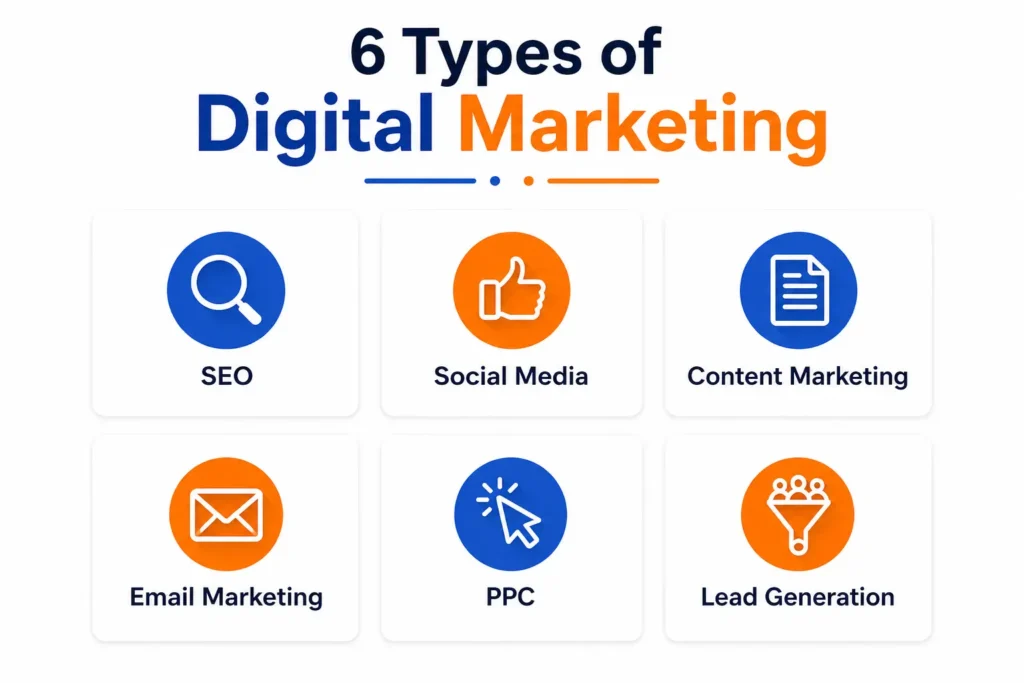
Digital marketing isn’t one single thing. It’s an umbrella term that covers several different channels and strategies. Here’s a clear breakdown of the most important ones:
1. Search Engine Optimization (SEO)
2. Content Marketing
Content marketing is the creation and distribution of valuable, relevant content — blog posts, guides, videos, infographics, case studies — that attracts and educates your target audience.
Content marketing and SEO work hand in hand. Good blog posts give Google a reason to show your website to people. Your educational content gives potential clients a reason to trust you. Your guides demonstrate expertise before a prospect ever speaks to your team.
3. Social Media Marketing
4. Pay-Per-Click Advertising (PPC / Google Ads)
PPC advertising, called pay-per-click, pays to place your business at the top of search results or across websites, social platforms, and apps. You pay only when someone clicks your ad.
Google Ads is the most powerful PPC platform — it puts your business at the top of search results for specific keywords immediately, without waiting months for organic SEO rankings to build.
PPC is fast. It can generate leads within hours of launching. But it requires continuous investment — the moment you stop paying, the traffic stops. It works best when used strategically alongside SEO for long-term, sustainable growth.
5. Email Marketing
Email marketing is one of the oldest digital marketing channels — and still one of the most effective.
Building an email list of existing customers, prospects, and leads gives you a direct communication channel that no algorithm can take away. Social media is great, but here’s the problem — if Instagram or Facebook changes its algorithm tomorrow, your reach can drop overnight. With email, that doesn’t happen. When someone gives you their email address, you have a direct line to them. No algorithm in the way, no guessing game.
And in 2026, the best email marketing isn’t about sending the same message to everyone. It’s about sending the right message to the right person at the right time — automatically. The right message to the right person at the right stage of their journey — triggered by their actions, not by a calendar reminder.
6. Lead Generation
7. Web Design and Development
8. Graphic Design and Branding
Why Digital Marketing Matters for Your Business in 2026
Let’s be direct: if your business doesn’t have a digital marketing strategy in 2026, you will be invisible to a huge portion of your potential market.
Here’s why it matters more now than ever:
Your customers are online. Before anyone calls your business, walks into your store, or fills out your contact form, they search online first. They check your website. They look at your social media. They read reviews. If you’re not there, you lose before the conversation even starts.
Your competitors are already doing it. Every day you don’t invest in digital marketing is a day your competitors are building the online authority, content library, and search rankings you’ll have to catch up to.
It’s measurable. Unlike traditional marketing, every digital marketing action is trackable. You know exactly how many people visited your website, where they came from, what they looked at, and whether they took action.
It levels the playing field. A well-executed digital marketing strategy lets a small business compete for attention and customers that used to be accessible only to large corporations with massive advertising budgets.
Digital Marketing in 2026: What's Changed
Digital marketing is not static. The fundamentals remain, but the landscape evolves constantly. Here’s what’s specifically different in 2026 that every business needs to understand:
AI search is changing how people find information. Google’s AI Overviews, ChatGPT, and Perplexity are providing direct answers rather than just lists of links. Unlike traditional SEO, which focuses on keyword density and backlinks, the new discipline of Answer Engine Optimization prioritizes the authority of information and the ability of a brand to provide direct, verifiable value to AI-powered queries. Your content needs to be structured, authoritative, and genuinely helpful.
Short-form video is a primary discovery channel. People don’t just search on Google anymore. They discover businesses through Instagram Reels, TikTok, and YouTube Shorts. If your business has no video presence, you’re missing a massive audience.
Authenticity outperforms polish. Consumers in 2026 are increasingly skeptical of high-production corporate content — preferring human-centric content that feels real and relatable. Brands that empower employees to share authentic stories and real experiences build stronger trust than those broadcasting polished campaigns.
How to Get Started With Digital Marketing
If you’re new to digital marketing, the most important thing is to start — strategically, not randomly.
Here’s a simple framework for beginners:
Step 1: Get your website right first. Your website is your digital home base. Make sure it’s fast, mobile-friendly, professionally designed, and clearly communicates what you do and who you serve.
Step 2: Start with SEO. Identify the keywords your ideal customers are searching for. Create content that answers their questions. Build your organic presence from day one — even if results take a few months.
Step 3: Choose one or two social media platforms. Don’t try to be everywhere at once. Pick the platforms where your audience actually spends time and build a consistent presence there first.
Step 4: Build your email list. Even a small, engaged email list is one of the most valuable assets a business can have. Start collecting emails from day one and nurture those subscribers with valuable content.
Step 5: Track everything. Set up Google Analytics and Google Search Console immediately. You can’t improve what you don’t measure. These free tools show you what’s working and where to focus next.
Step 6: Get professional help when you need it. Digital marketing has a learning curve. For businesses that want faster results without the trial-and-error, working with a professional digital agency delivers significantly better outcomes at a lower total cost than building expertise in-house from scratch.
At Alpha Digitix, we work with businesses at every stage — from building their first digital presence to scaling established marketing strategies. Whether you need SEO, virtual assistance, or a complete lead generation system, our team is ready to help you move forward with a strategy built for 2026.
Conclusion
Frequently Asked Questions (FAQs)
Digital marketing is promoting your business online — through search engines, social media, email, content, and paid advertising — to attract, engage, and convert customers.
The main types are SEO (search engine optimization), content marketing, social media marketing, PPC/Google Ads, email marketing, lead generation, and web design.
Digital marketing costs vary widely depending on the channels and approach. SEO and content marketing require time and expertise, but deliver free organic traffic once they rank. PPC requires ongoing ad spend. Social media can be started at no cost.
It depends on the channel. Google Ads and paid social can generate results within days. SEO typically takes 3–6 months to show meaningful organic rankings. Content marketing compounds over time — the more you publish, the more authority you build. Email marketing results depend on your list size and quality.
In 2026, your potential customers are searching for what you offer online before they ever contact you. If you're not visible in search results, on social media, or in their inbox, you're losing clients to competitors who are.