- Rehman
- 1:47 pm
- April 17, 2026
You need more help — more skills, more hours, more output. But the question isn’t just who should do the work. It’s how you bring them in. Do you hire a full-time employee and build an internal team? Or do you outsource to a specialist, an agency, or a virtual assistant?
It sounds like a simple decision. It rarely is.
Both options come with real advantages — and real trade-offs. The right answer depends on your business size, your budget, the type of work you need done, and where you are in your growth journey.
In this guide, we’ll break it all down so you can stop second-guessing and make a decision that actually fits your business.
What Does It Mean to Build an In-House Team?

An in-house team means you hire employees directly — people who work exclusively for your business, under your roof (or in your virtual workspace), fully dedicated to your goals.
They know your brand inside out. They’re available during your working hours. They attend your meetings, understand your processes, and grow with your company culture over time.
Sounds ideal, right? In many ways, it is. But here’s what most business owners don’t account for upfront — the true cost of an in-house hire goes far beyond the monthly salary.
When you bring someone in-house, you’re also taking on:
- Recruitment costs — job postings, interviews, onboarding time
- Employee benefits — health insurance, paid leave, bonuses
- Equipment & software — laptops, licenses, tools
- Office space — rent, utilities, furniture (if not remote)
- Training — getting them up to speed takes weeks, sometimes months
- Management overhead — someone has to supervise, review, and develop them
For large enterprises with stable, ongoing needs, this investment makes sense. For startups and small businesses still finding their footing, it can become a heavy financial burden very quickly.
What Is Outsourcing?

Outsourcing means hiring an external individual, agency, or team to handle specific tasks or functions for your business — without bringing them on as a full-time employee.
You might outsource your SEO to a digital agency. Your graphic design to a freelancer. Your customer support to a virtual assistant. Your web development to a specialized firm.
The outsourced partner works on your projects, delivers results, and you pay for what you actually need — no salaries, no benefits, no overhead.
The outsourcing market has matured significantly — companies now outsource not just to cut costs, but to access specialized expertise and innovation they simply can’t find or afford locally.
And the numbers back it up. 57% of companies cite cost reduction as their primary outsourcing objective, with businesses saving anywhere from 20% to 70% on operational costs depending on the function.
That’s not a small number. For a growing business watching every dollar, those savings can be redirected into growth — better tools, more marketing, product development.
Outsourcing vs In-House: The Real Cost Comparison
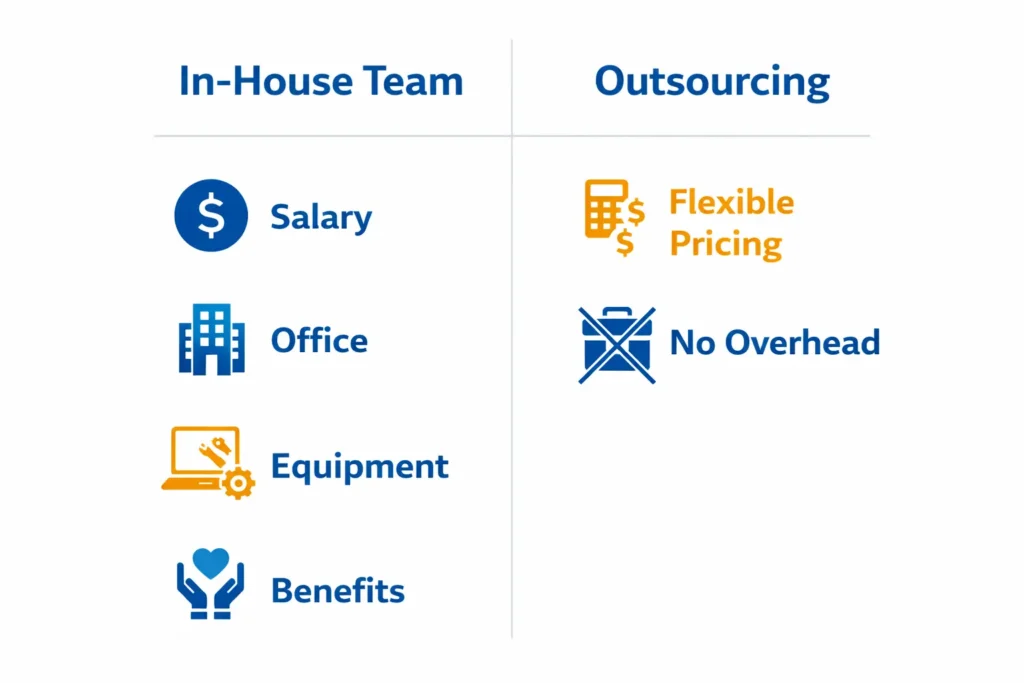
Let’s put the numbers side by side — because this is where the decision usually gets made.
| Factor | In-House Team | Outsourcing |
|---|---|---|
| Monthly Cost | Salary + benefits + overhead | Pay per project or retainer |
| Hiring Time | 4–8 weeks minimum | 24–72 hours |
| Skill Set | Limited to who you hired | Access to entire specialist team |
| Scalability | Slow — hire, train, onboard | Instant — scale up or down |
| Control | High — direct daily oversight | Outcome-based — you define results |
| Commitment | Long-term contract | Flexible — cancel anytime |
| Training Required | Yes — weeks to months | No — experts from day one |
| Best For | Core, ongoing business functions | Specialized, project-based work |
When you look at it this way, the decision becomes clearer. In-house makes sense for roles that are central to your daily operations and require deep internal knowledge. Outsourcing wins for specialized skills, project-based work, and functions where you need expertise without the overhead.
When In-House Is the Right Call
Let’s be fair — there are situations where building an in-house team genuinely is the better choice.
You should consider in-house when:
- The role requires deep, long-term knowledge of your brand, products, or customers
- You need someone available instantly during business hours, every day
- The function is core to your business — not peripheral
- You’re at a stage where you can afford the full cost of employment
- You want to build a strong internal culture around a specific team
For example, if you’re running an e-commerce business and customer relationships are everything, having an in-house customer service lead who knows your products deeply can make a real difference. That’s not a role you want to hand off carelessly.
When Outsourcing Is the Smarter Move
For most small businesses, startups, and growing brands — especially in the early stages — outsourcing delivers more value, faster.
Outsourcing wins when:
- You need specialized skills your local talent pool doesn’t have
- The work is project-based or fluctuates in volume
- You want to move fast without a lengthy hiring process
- Budget is a priority and overhead needs to stay lean
- You want access to a full team — not just one person
Think about it this way: hiring a full-time SEO manager, a graphic designer, a web developer, and a virtual assistant would cost tens of thousands of dollars per month in salaries alone. Outsourcing those same functions to a specialized agency gives you an entire team of experts — at a fraction of that cost.
This is exactly what we do at Alpha Digitix. Businesses across the UAE and globally work with us to handle their SEO, web development, graphic design, and virtual assistant needs — without the cost, commitment, or complexity of building those teams in-house.
The Hybrid Approach: Best of Both Worlds
Here’s something most comparison articles won’t tell you — you don’t have to choose one or the other permanently.
Many smart businesses use a hybrid model. They keep one or two core team members in-house for strategy and relationship management, then outsource execution-heavy work to specialists.
For example:
- In-house: Business owner + operations manager
- Outsourced: SEO, design, development, VA tasks, lead generation
This gives you control where it matters, and flexibility where it saves money. You stay lean, move fast, and still get high-quality output across every function.
As your business grows, you can shift the balance — bring more in-house as revenue justifies it, or scale outsourcing further as demand increases.
Which One Is Right for Your Business Right Now?

Here's a quick decision framework:
Choose In-House if:
- You have stable, predictable revenue
- The role is a permanent, daily operational need
- Deep brand knowledge is non-negotiable
- You can absorb full employment costs
Choose Outsourcing if:
- You're in early growth stage and watching costs
- You need specialized skills quickly
- The work is project-based or variable
- You want to stay lean and move fast
Choose Hybrid if:
- You have a small core team but growing needs
- You want control over strategy, flexibility in execution
- You're scaling and need to adapt quickly
If you’re a startup or small business trying to grow in 2026 without burning through budget on premature hiring — outsourcing is almost always the smarter starting point.
And when you’re ready to explore what professional outsourcing actually looks like for your business, Alpha Digitix is here to help.
Conclusion
The outsourcing vs in-house debate doesn’t have a universal winner — it has a right answer for each business, at each stage of growth.
What we know for certain: in 2026, outsourcing is no longer just a cost-cutting move. It’s a strategic decision that gives businesses access to world-class talent, faster execution, and the flexibility to scale without the risks of premature hiring.
Start lean. Stay focused. Outsource what you can. Build in-house when you must.
And if you’re looking for a reliable team to handle your digital work — from SEO and web development to design and virtual assistance — what Alpha Digitix offers and let’s talk about what fits your business best.
Frequently Asked Questions (FAQs)
In most cases, yes — especially for small businesses. When you factor in salary, benefits, equipment, training, and management time, in-house hiring costs significantly more than outsourcing the same function to a specialist or agency.
Specialized or project-based work is ideal for outsourcing — SEO, graphic design, web development, virtual assistance, lead generation, data entry, and social media management are among the most commonly and successfully outsourced functions.
Not at all. When you work with a reputable agency or specialist, outsourced work is often higher quality than what a single in-house generalist can deliver — because you're getting a dedicated expert in that specific area.
Outsourcing is actually more affordable for small businesses than building an in-house team. You pay only for what you need, with no overhead, benefits, or long-term commitments.
Look for verified reviews, a strong portfolio, clear communication, and transparent pricing. A reliable agency will be upfront about what they deliver, how they deliver it, and what you can expect.