- Rehman
- 2:01 am
- April 28, 2026
Lead generation mistakes Mistake #1: Chasing Quantity Over Quality
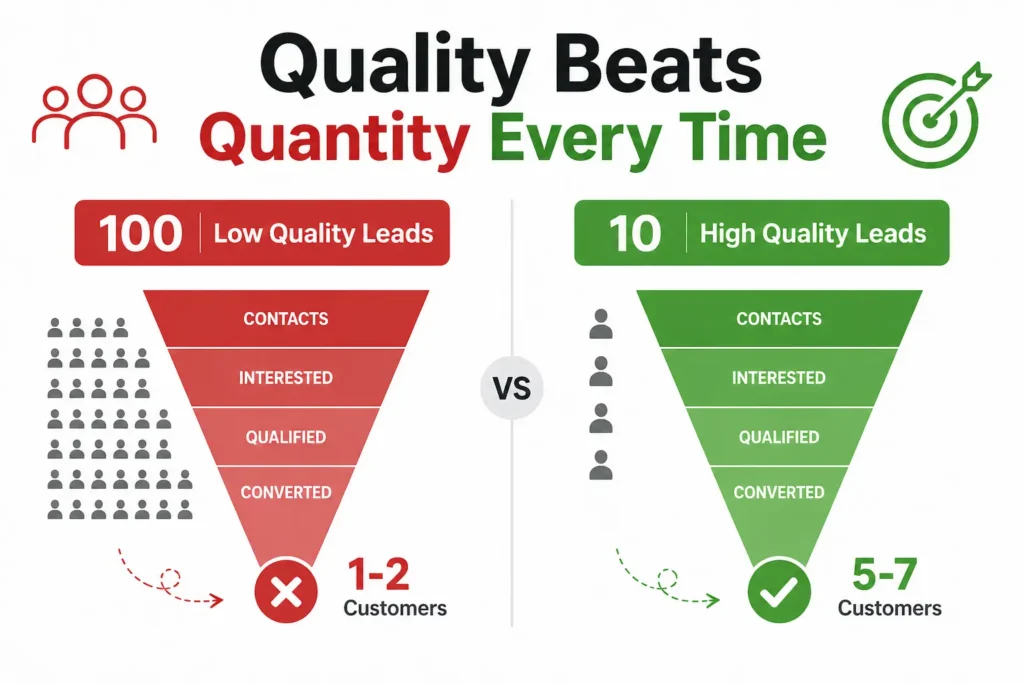
More leads sound like a good thing. And it is — until you realize your team is spending hours chasing people who were never going to buy in the first place.
The most damaging mistake in lead generation is targeting anyone who shows mild interest instead of identifying leads with a genuine intent to buy. This leads to wasted effort and frustration when sales cycles stall, and prospects fail to convert. ProfitPathLogic
Think about it practically. One hundred leads from people casually browsing your website is worth far less than ten leads from people who are actively comparing solutions and ready to make a decision. The first group drains your time. The second group builds your revenue.
The root cause of this mistake is almost always a poorly defined Ideal Customer Profile (ICP). Without knowing exactly who your best client is — their industry, their pain points, their budget range, their decision-making process — every campaign you run will attract a wide, unqualified mix of people.
How to fix it:
Define your ICP with real specificity. Go beyond “small businesses” or “companies in the UAE.” Get detailed — what size company, what problem are they solving, what’s their timeline, what do they value in a service provider? Then build every campaign, landing page, and piece of content around that person specifically.
Stop measuring success by form submissions alone. Optimize for quality with better messaging, segmentation, and qualification criteria at the top of your funnel. Agents Republic
Lead generation mistakes Mistake #2: Having No Follow-Up System
This one is staggering — and yet it’s one of the most common mistakes businesses make.
44% of sales representatives never follow up with a lead at all, leaving significant revenue on the table. Kuubiik Nearly half. That means almost half of the leads businesses pay to generate are simply abandoned.
And the ones that do follow up? Many do it too slowly. Studies show that following up with a lead within five minutes makes you significantly more likely to convert them. Many businesses delay their response, allowing interest to fade and competitors to step in. Remotelytalents
Here’s the reality: a person who fills out your contact form is at their peak interest at that exact moment. Every hour that passes without a response is an hour your competitor has to reach them first.
How to fix it:
Build an automated follow-up system that responds immediately. A well-configured CRM with automated email sequences, chatbot responses for after-hours inquiries, and sales team alerts for new leads eliminates the gap between interest and contact.
At a minimum, set up:
An instant auto-response email confirming receipt and setting expectations
A follow-up sequence of 3–5 emails over 7–14 days for leads that don’t respond immediately
Sales team notifications so a real person follows up within the same business day
The businesses that respond fast win the client. It’s that simple.
Lead generation mistakes Mistake #3: Targeting Everyone and Converting No One
Lead generation mistakes Mistake #4: Ignoring Your Landing Page
Lead generation mistakes , You can have the best ad campaign in the world. But if the page it sends people to is slow, confusing, or has a weak call-to-action, you’re throwing money away.
Your landing page is where the decision happens. It’s where a visitor either becomes a lead or leaves forever. And most businesses treat it as an afterthought.
Common landing page mistakes that kill lead generation:
Slow load time — Every second of page load delay reduces conversions by approximately 7%. A five-second load time costs you roughly 35% of potential leads compared to a one-second load. Martal Group Speed is not optional.
No clear headline — Visitors decide in 3 seconds whether to stay or leave. If your headline doesn’t immediately communicate what you offer and who it’s for, they’re gone.
Weak or buried CTA — “Submit” is not a call to action. “Get Your Free SEO Audit” or “Start Generating More Leads Today” tells the visitor exactly what happens next and why it benefits them.
Too many distractions — Navigation menus, social media links, and unrelated content pull attention away from the one thing you want the visitor to do
No social proof — Testimonials, reviews, client logos, and case study results directly on the landing page dramatically improve conversion rates.
How to fix it:
Audit your landing pages with one question: Does every single element on this page move the visitor toward taking action? If something doesn’t contribute to that goal, remove it. A clean, fast, focused landing page built on a professionally developed website will outperform a cluttered one every time.
Lead generation mistakes Mistake #5: Generating Leads but Never Nurturing Them
Lead generation mistakes, Most of your leads are not ready to buy today. And that’s completely normal.
The mistake businesses make is treating unready leads as failures and moving on — when in reality, those leads represent the most valuable part of their pipeline. They’re interested. They’re just not ready yet.
Nurtured leads make purchases 47% larger than non-nurtured leads. Kuubiik Nearly half more revenue — from leads you already have, at no extra acquisition cost. That’s the power of a proper nurturing system.
Without nurturing, here’s what happens: someone finds your business, shows interest, gets no follow-up communication, forgets about you, and eventually buys from a competitor who stayed in touch. You did the hard work of generating the lead. Your competitor did the easy work of staying relevant — and they got the client.
How to fix it:
Build a nurturing sequence that keeps your brand in front of prospects over time. This doesn’t mean spamming them daily. It means delivering genuine value consistently — educational content, case studies, tips relevant to their industry, and occasional soft offers.
A strong nurturing system includes:
Email sequences tailored to where the prospect is in their journey
Retargeting ads that keep your brand visible after the initial visit
Content marketing through blogs, social posts, and guides that address their questions
Personalized outreach for high-value prospects at the right moment
Companies that excel at lead nurturing generate 50% more sales-ready leads at 33% lower cost. ALM Corp, That’s not a minor competitive advantage — that’s a fundamentally different business outcome from the same leads you’re already generating.
How to Fix Your Lead Generation — A Clear Action Plan

| Action | Priority |
|---|---|
| Define your Ideal Customer Profile with real specificity | 🔴 High |
| Set up an automated follow-up system that responds within minutes | 🔴 High |
| Audit your landing pages for speed, clarity, and CTA strength | 🔴 High |
| Create audience-specific messaging for each segment | 🟡 Medium |
| Build a nurturing sequence for leads not yet ready to buy | 🟡 Medium |
| Implement lead scoring to prioritize your highest-quality prospects | 🟡 Medium |
| Review and track conversion metrics monthly — not quarterly | 🟢 Ongoing |
Conclusion
Frequently Asked Questions (FAQs)
The most common mistake is prioritizing lead volume over lead quality. Businesses focus on generating as many leads as possible without qualifying them, which results in a full pipeline that produces very few actual clients. Defining your ideal customer profile and targeting specifically is the fastest fix.
As quickly as possible — ideally within 5 minutes of the lead coming in. The longer you wait, the colder the lead becomes. Set up automated instant responses and same-day follow-up alerts for your sales team to eliminate any delay.
Most conversions happen after multiple touchpoints. A follow-up sequence of 5–7 attempts over 2–3 weeks is standard. Don't abandon a lead after one or two attempts — many clients convert on the third, fourth, or fifth contact.
Lead nurturing is the process of staying in consistent, valuable contact with leads that aren't ready to buy yet — through email sequences, content, retargeting ads, and personalized outreach. Nurtured leads not only convert more often, but they also spend significantly more when they do.
Run your page through Google PageSpeed Insights to check load time. Review your bounce rate in Google Analytics — a rate above 70% on a lead generation page is a warning sign. Check your CTA: is it specific, visible, and benefit-focused? If your page is slow, confusing, or has a weak call-to-action, it's costing you leads.